
BPM Flow for GTA Businesses: A 7-Step Workflow System to Remove Bottlenecks and Scale Faster
Growth is exciting, but for many Greater Toronto Area business owners, it also exposes every weak spot inside the company.
The sales team closes more deals, but onboarding slows down. Customers expect faster service, but approvals get stuck. Employees work harder, yet tasks still fall through the cracks. The owner becomes the backup system for everything.
That is usually not a people problem. It is a business process problem.
A clear bpm flow helps you see exactly how work moves through your business, where it gets delayed, who owns each step, and which parts can be improved or automated. For growing GTA businesses, this can be the difference between scaling confidently and constantly putting out fires.
In this guide, you will learn what BPM flow is, why it matters, how to build one, and how to use the WittySolutions BPM Flow Scorecard to identify the processes that are slowing your business down.

What Is BPM Flow?
BPM flow stands for Business Process Management flow. It is the structured path that work, information, decisions, and approvals follow from start to finish inside a business process.
A simple workflow might show a list of tasks. A true bpm flow goes deeper. It shows:
- Who starts the process
- What steps need to happen
- Who owns each step
- What decisions are required
- What happens when something goes wrong
- Where automation can reduce manual work
- How success will be measured
For example, a client onboarding bpm flow might show how a new client moves from signed agreement to intake form, internal handoff, kickoff meeting, service delivery, billing, and follow-up.
Instead of relying on memory, scattered emails, or “the way we usually do it,” bpm flow gives your team a clear operating system.
According to experts at the University of Denver Daniels College of Business, business process management uses various methods to discover, model, analyze, measure, improve, and optimize business processes.
Why BPM Flow Matters for GTA Business Owners
The GTA is a competitive market. Whether you run a professional services firm, construction company, retail business, healthcare clinic, marketing agency, or e-commerce operation, customers expect speed, consistency, and professionalism.
As your business grows, informal processes stop working.
You may start noticing problems like:
- Customers are waiting too long for updates
- Team members are duplicating work
- Approvals sitting in someone’s inbox
- New employees need too much hand-holding
- The owner is being pulled into every decision
- Mistakes are happening because no one owns the next step
These issues are expensive. They reduce capacity, hurt customer experience, frustrate employees, and make growth harder than it needs to be.
A well-designed BPM flow creates clarity. Everyone knows what happens next, who is responsible, and how work should move. That makes the business easier to manage, easier to delegate, and easier to scale.
The WittySolutions BPM Flow Scorecard
Before improving a process, you need to know how broken it is.
Use this simple scorecard to evaluate any workflow in your business. Score each category from 1 to 5, where 1 means weak and 5 means excellent.
| BPM Flow Area | Question to Ask | Score |
|---|---|---|
| Clarity | Can every team member explain how this process works? | /5 |
| Ownership | Does every step have one clear owner? | /5 |
| Speed | Does work move quickly, or does it sit idle? | /5 |
| Consistency | Is the process followed the same way every time? | /5 |
| Automation | Are repetitive steps automated where possible? | /5 |
| Measurement | Are cycle time, errors, and outcomes tracked? | /5 |
How to interpret your score
- 25–30: Strong process. Look for small automation opportunities.
- 18–24: Functional but inconsistent. Improve handoffs and measurement.
- 10–17: Process is slowing growth. Prioritize redesign.
- Below 10: High-risk workflow. This likely needs immediate attention.
This scorecard turns process improvement from a vague idea into a practical business decision.
Example: How a GTA Service Business Can Use BPM Flow
Imagine a growing GTA-based service company that handles client onboarding manually.
Before BPM flow A new client signs an agreement. The sales rep emails operations. Operations asks the client for missing details. Finance waits for billing information. The owner gets copied into several email threads. The client receives updates inconsistently.
The result? Onboarding takes 7 business days, the client feels unsure, and the team wastes time chasing information.
After BPM flow The company maps the onboarding process and creates a better flow:
- Signed agreement triggers a client intake form.
- Intake form automatically creates a task for operations.
- Operations reviews the file within 24 hours.
- Finance receives billing details automatically.
- The client receives a welcome email with next steps.
- The project manager schedules the kickoff call.
- Leadership reviews onboarding cycle time monthly.
Now the same process takes 2–3 business days, fewer details are missed, and the owner is no longer the person holding everything together.
That is the practical power of bpm flow.
Core Components of an Effective BPM Flow
A strong BPM flow is not just a diagram. It is a working system. These are the key components every business should include.
1. Clear Start and End Points: Every process needs a defined beginning and ending. Without clear boundaries, processes become messy and hard to improve.
2. Defined Roles and Responsibilities: Every step needs an owner. Avoid vague ownership like “admin team.” Assign responsibility clearly so accountability improves.
3. Decision Points: Most business processes involve decisions. Clear rules remove guesswork and keep work moving.
4. Handoffs: This is where many processes break. A good bpm flow answers who sends the handoff, who receives it, what information must be included, and what happens if the deadline is missed.
5. Automation Opportunities: Once a process is mapped, you can see which steps should not be manual. Common opportunities include sending confirmation emails, creating tasks, updating CRM records, and routing approvals. Automation works best after the process is clear.
6. Exception Handling: Real business processes do not always follow the perfect path. Your bpm flow should show what happens when something goes wrong, so small issues do not become major delays.
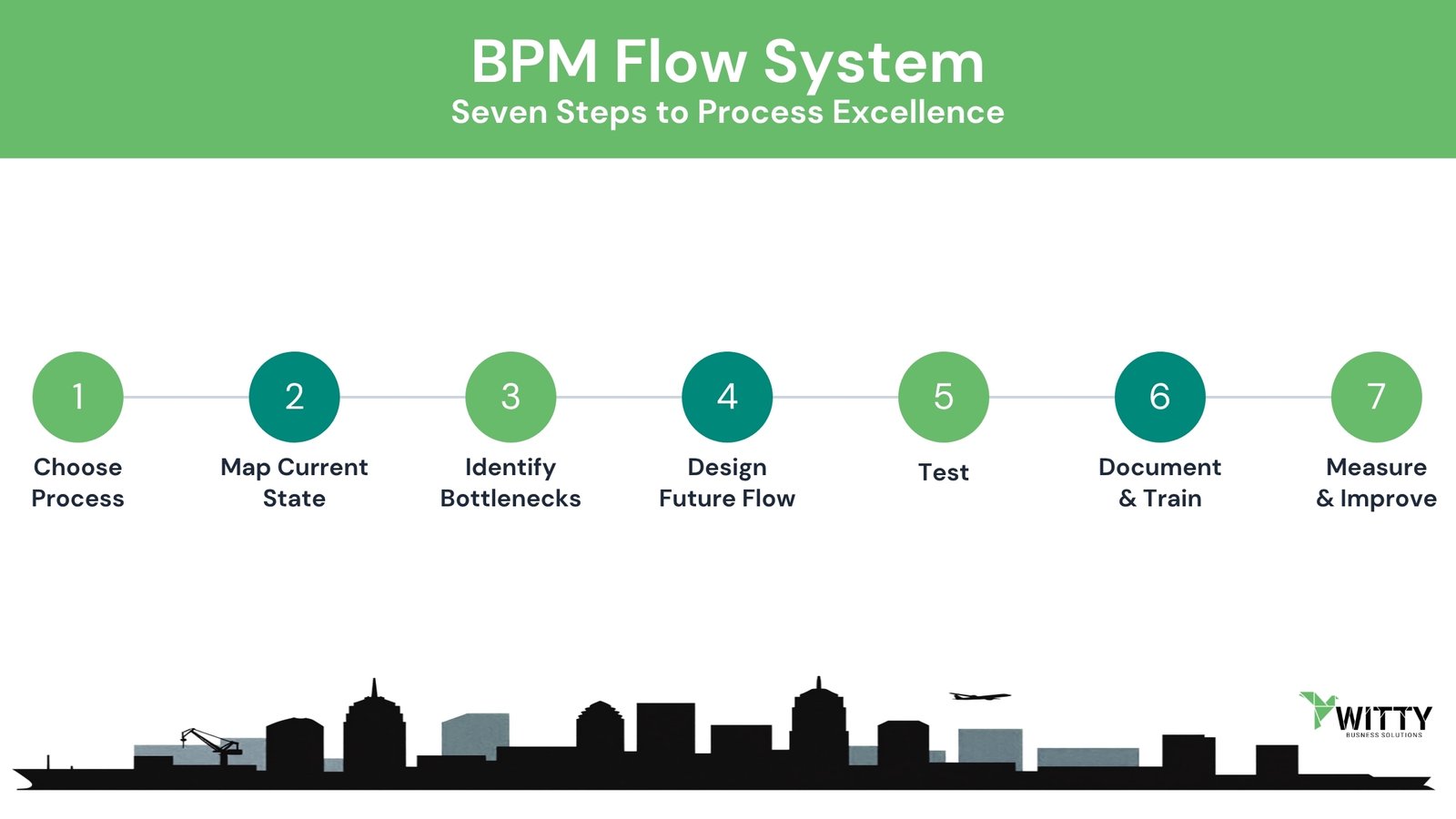
A 7-Step System to Build Your First BPM Flow
You do not need to map your entire business at once. Start with one high-impact process and improve from there.
Step 1: Choose One Process That Causes Pain: Start with a process that happens often and creates problems when it goes wrong. Good starting points include client onboarding, invoice approval, new employee onboarding, or sales handoff to operations.
Step 2: Map the Current Process Honestly: Do not map the process the way you wish it worked. Map it the way it actually works today. Bring in the people who do the work every day and ask what happens first, where they wait, where errors happen, and what workarounds they use.
Step 3: Identify Bottlenecks: Look for places where work slows down, repeats, or gets stuck. Common bottlenecks include too many approvals, missing information, manual data entry, unclear ownership, and slow handoffs.
Step 4: Design the Future-State BPM Flow: The improved flow should be easier to understand, faster to complete, clearer in ownership, more consistent, easier to measure, and ready for automation. Remove unnecessary steps and build in exception paths.
Step 5: Test the New Flow: Do not roll out a new bpm flow across the entire company immediately. Test it with a small number of real cases first and gather feedback from the team.
Step 6: Document and Train the Team: A BPM flow only works if people can follow it. Create simple documentation that includes a visual process map, step-by-step instructions, role responsibilities, approval rules, escalation paths, and success metrics. Then train the people involved.
Step 7: Measure and Improve: Your bpm flow should not sit in a folder and get forgotten. Track key metrics such as cycle time, error rate, rework, missed deadlines, customer satisfaction, and capacity gained. Review the process monthly at first, then quarterly.
Strong business process management is continuous. As your business changes, your workflows should improve with it.
Enterprise BPM Flow Tools for Organizational Process Management
For a true organizational bpm flow, you need more than a basic project management board. Tools like ClickUp and Monday.com can help teams track tasks, but enterprise BPM platforms are designed to model, automate, govern, monitor, and continuously improve processes across departments.
The best BPM tool depends on whether your business needs simple process mapping, workflow automation, case management, process mining, or full enterprise process orchestration.
Popular options include Flowable, Camunda, Microsoft Power Automate and Power Apps Business Process Flows, SAP Signavio and SAP Build Process Automation, IBM Business Automation Workflow, Appian, Pega, Oracle Process Automation, Nintex, and Bizagi.
How to Choose the Right BPM Flow Tool
Do not start by choosing software. Start by understanding the process problem.
Use this simple guide:
- Map and document workflows: Bizagi, SAP Signavio, Nintex Process Manager
- Automate approvals and internal workflows: Microsoft Power Automate, Nintex, SAP Build Process Automation
- Build enterprise BPMN workflows: Flowable, Camunda, IBM Business Automation Workflow
- Manage complex cases: Flowable, Pega, IBM, Appian
- Improve SAP-heavy processes: SAP Signavio, SAP Build Process Automation
- Build low-code process apps: Appian, Pega, Oracle Process Automation, Microsoft Power Platform
- Analyze how processes actually run: SAP Signavio Process Intelligence, Microsoft Process Mining, Appian Process Mining
For many growing GTA businesses, the best path is to start with process mapping, then move into automation once the workflow is clear. Automating a broken process usually creates faster chaos.
The official standard for visualizing these flows is Business Process Model and Notation (BPMN), available at https://www.bpmn.org/.
Common BPM Flow Mistakes to Avoid
Mistake 1: Starting Too Big Many business owners try to map everything at once. This becomes overwhelming. Start with one process. Improve it. Measure the results. Then move to the next one.
Mistake 2: Ignoring the Team The people doing the work usually know where the process breaks. If leadership designs the workflow without employee input, the final process may look good on paper but fail in practice.
Mistake 3: Creating a Flow No One Uses A bpm flow should be practical. If the process is too complicated, people will avoid it. Keep it clear, simple, and easy to follow.
Mistake 4: Automating Too Early Automation should come after process clarity. If your workflow is unclear, automation can make mistakes happen faster. First simplify the process, then automate the repeated steps.
Mistake 5: Not Measuring Results If you do not measure the process, you cannot prove whether it improved. Track basic metrics before and after implementation so you can see the business impact.
Business process management is not a passing trend. It is a long-term discipline, as highlighted in insights from UC Berkeley.
How BPM Flow Supports Business Process Optimization
BPM flow is one part of a larger business process optimization strategy.
Each improved workflow removes friction from one area of the company. Over time, those improvements compound.
For example:
- A better sales handoff improves service delivery.
- A better onboarding flow improves customer experience.
- A better invoice approval flow improves cash flow.
- A better hiring workflow improves team growth.
- A better support process improves retention.
When these flows connect, the entire business becomes more predictable and scalable.
How to Know If Your BPM Flow Is Working
A BPM flow should produce measurable improvement. Track these indicators:
Cycle Time — How long does the process take from start to finish? If onboarding used to take 7 days and now takes 3, your flow is creating real value.
Error Rate — How often does the process create mistakes, missing information, or rework? A strong bpm flow should reduce errors over time.
Team Feedback — Ask employees whether the new process makes their work easier or harder.
Customer Experience — Look at customer complaints, response times, satisfaction scores, and repeat business.
Capacity — Can your team now handle more work without adding more people? This is one of the strongest signs that process improvement is supporting growth.
FAQs
What is the difference between BPM flow and workflow?
Do small businesses need BPM flow?
Can BPM flow be automated?
What BPM flow should I start with?
How often should BPM flows be reviewed?
Final Thoughts
A strong bpm flow gives your business clarity.
It shows your team how work should move, who owns each step, where decisions happen, and how delays can be prevented. For GTA business owners trying to scale, that clarity can unlock time, capacity, and consistency.
You do not need to fix every process at once. Start with one workflow that creates friction today. Map it, score it, improve it, test it, and measure the results.
Once you see how much smoother one process can become, you can apply the same approach across the rest of your business.
Need help mapping your first BPM flow?
WittySolutions helps GTA business owners identify bottlenecks, document workflows, and build practical systems that support growth. Book a process audit today and start turning operational chaos into scalable process clarity.
Other Posts




Let's Drive Your Business Forward
Ready to take your business to the next level? Let Witty Solutions guide you with expert strategies and innovative solutions. Let’s drive success together!
