Every startup founder in Canada dreams of explosive startup growth, but most stumble without a clear roadmap. The startup growth cycle provides that exact framework. It outlines the predictable stages every successful company moves through, from idea to exit, so you can grow startups intentionally instead of guessing.
Understanding the startup growth cycle helps founders avoid common traps, secure the right funding at the right time, and scale efficiently in a competitive market. Whether you are pre-seed or preparing for Series A, this guide delivers practical insights tailored to startup growth in the Greater Toronto Area.

What Is the Startup Growth Cycle?
The startup growth cycle is the repeatable sequence of phases that transform an early idea into a mature, scalable business. Unlike random “hockey-stick” growth, it follows structured steps where each stage builds on the last.
Healthy growth in startups means moving deliberately through these phases while hitting specific milestones. Founders who master the startup growth cycle raise capital faster, retain talent longer, and achieve sustainable startup growth instead of burning out.
For GTA-based founders, the cycle also accounts for local realities: access to Ontario innovation grants, talent from top universities, and a vibrant tech ecosystem that rewards smart business development.
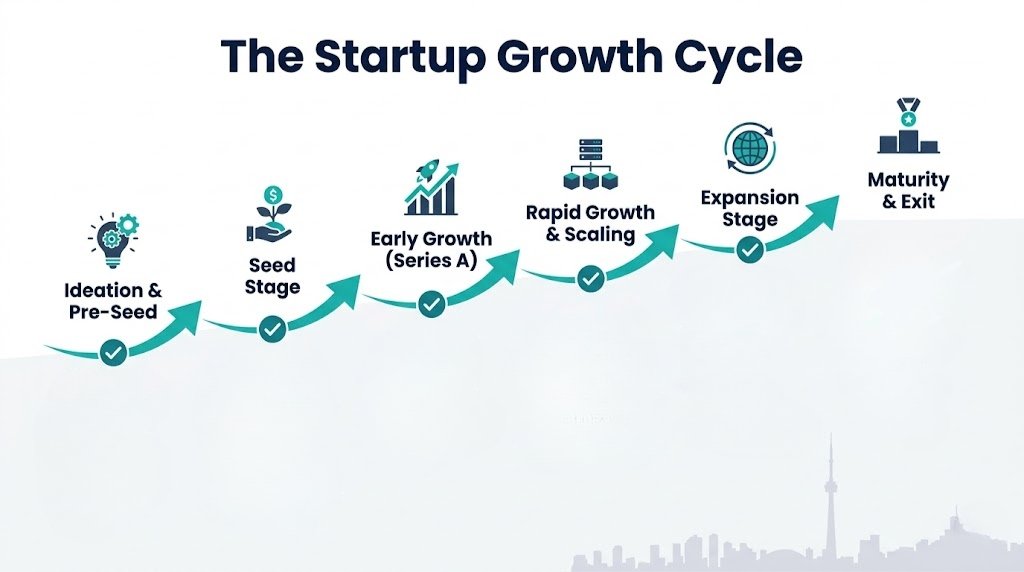
The 6 Key Stages of the Startup Growth Cycle
Stage 1: Ideation and Pre-Seed
This is where it all begins. You validate your idea, build a minimum viable product, and test assumptions with early users. Focus on customer interviews and basic prototypes.
Key milestones include problem-solution fit and initial user feedback. Common pitfalls? Falling in love with your idea before proving demand. Avoid this by running quick experiments and iterating fast.
Stage 2: Seed Stage
Product-market fit becomes your north star. You launch a working product, secure your first paying customers, and raise seed capital. Early traction metrics matter more than perfection.
Canadian founders often tap into SR&ED tax credits and local angel networks here. The goal is to prove you can grow startups beyond the founder’s personal network.
Stage 3: Early Growth (Series A)
Revenue starts compounding. You expand the team, refine processes, and double down on what works. This stage separates serious players from hobby projects.
Hiring your first key executives and establishing repeatable sales playbooks are critical. Many GTA startups use this phase to expand within Ontario before eyeing national or international markets.
Stage 4: Rapid Growth and Scaling
This is where aggressive startup growth happens. You optimize unit economics, invest heavily in marketing and sales, and push toward $1M+ ARR.
Focus shifts to systems that let the business run without you. Founders who master this stage learn to grow startups while keeping culture and quality intact.
Stage 5: Expansion Stage
You enter new markets, launch additional products, or deepen penetration in existing ones. Operational efficiency and profitability become priorities.
Ontario founders often leverage provincial programs and partnerships during expansion. This phase tests whether your startup growth model is truly repeatable.
Stage 6: Maturity and Exit
The business reaches steady-state profitability. Leadership focuses on optimization, potential acquisition, or IPO preparation.
Not every founder wants to exit, but understanding this final stage of the startup growth cycle helps you make strategic decisions long before you get there.
For deeper reading on transitioning between these phases, see this excellent resource from Stanford Online: Mind the Gap: the 5 Key Transitions From Early-Stage to Growth-Stage Startups.
Essential Metrics for Tracking Startup Growth
You cannot improve what you do not measure. Track these KPIs by stage to know exactly where you stand in the startup growth cycle:
- Pre-Seed/Seed: Customer acquisition cost (CAC), monthly recurring revenue (MRR), churn rate
- Early Growth: Lifetime value (LTV), burn rate, runway, revenue growth rate
- Scaling & Beyond: Gross margin, net promoter score (NPS), employee retention, CAC payback period
Use simple tools like Google Sheets or affordable platforms such as Baremetrics. Review metrics weekly in the early stages and monthly as you scale.
A recent study from Indiana Wesleyan University highlights how consistent KPI tracking directly correlates with faster startup growth. Read more here: From Startup to Scale-Up: Overcoming Growing Pains.

Common Challenges When Trying to Grow Startups
Even with a solid plan, most startups hit roadblocks. Funding gaps remain the top issue for GTA founders. Talent shortages in specialized roles like sales and engineering also slow progress.
Regulatory navigation in Ontario can feel overwhelming, especially around taxes, IP, and hiring foreign talent. Many companies stall in the rapid-growth stage because systems built for ten people break at fifty.
The good news? These challenges are predictable within the startup growth cycle. Recognizing them early lets you course-correct before they derail your momentum.
Proven Strategies to Accelerate Your Startup Growth Cycle
Want to move through the stages faster? Implement these tactics:
- Validate relentlessly in ideation and seed stages
- Build repeatable sales processes before heavy marketing spend
- Hire for culture fit and scalability during early growth
- Leverage local resources such as MaRS Discovery District and Ontario Centre of Innovation
- Focus on unit economics before chasing vanity metrics
Harvard Business School Online offers a fantastic framework for scaling thoughtfully: How to Scale a Business: 6 Tactics to Utilize.
How Business Development Support Can Shorten Your Timeline
Professional business development support acts as a force multiplier at every stage of the startup growth cycle. Expert partners help you identify the right opportunities, build strategic relationships, and avoid costly mistakes.
For GTA founders, dedicated BD support means faster access to local capital, enterprise clients, and government programs. It compresses timelines that would otherwise stretch months or years.
At Witty Solutions, we specialize in helping Ontario startups navigate exactly this journey. Our tailored business development services give founders the edge they need to achieve sustainable startup growth.

Conclusion
The startup growth cycle is not just theory; it is your proven roadmap to build something lasting. By understanding each stage, tracking the right metrics, and applying targeted strategies, founders in the GTA can achieve the startup growth they envision.
Ready to move to the next phase with confidence?
Take a moment right now to assess where your company sits in the cycle. The earlier you align your actions with these stages, the faster you will grow startups and create real value.